

The Enduring Appeal of Charles Dickens' London
A City of Sharp Contrasts
Charles Dickens did not invent Victorian London, but he did something almost as remarkable: he made it legible. In novel after novel he sets wealth and poverty within a few minutes' walk of one another, and the effect is still unsettling. A drawing room in Mayfair and a crumbling tenement in Seven Dials exist in the same city, often in the same chapter. Dickens knew both sides from the inside. His father's debts landed the family in the Marshalsea, and the twelve-year-old Charles was sent to work in a boot-blacking warehouse while his family sat in prison. That experience never left his writing, and it gives his London its moral weight.
What draws readers back, though, is not the politics but the texture. The counting houses, the legal warrens, the river at low tide, the smell of the streets after rain. Dickens noticed everything, and he wrote it down with a reporter's eye and a showman's instinct.
Streets You Can Still Walk
One of the pleasures of reading Dickens in Britain today is that so much of his geography survives. You can trace it on foot in an afternoon.
- Holborn and Chancery Lane — the legal heart of Bleak House, where fog and paperwork smother everything. The Inns of Court still feel like a maze deliberately designed to keep you there.
- Fleet Street and the Strand — coaching inns, print shops and the noise of commerce. Dickens worked this patch as a young journalist and knew its rhythms intimately.
- Seven Dials and St Giles — the crowded, desperate quarter that appears again and again, most memorably in Oliver Twist.
- Southwark and the Thames — wharves, mudlarks and the river as both livelihood and threat. Our Mutual Friend opens here, and the water does much of the work.
If you are reading a novel set in one of these areas, a map beside your chair is worth more than any introduction. Follow the characters as they walk. You will notice how often a short journey crosses a social boundary that ought to be unbridgeable.
Fog, Lamplight and the Weather of the Page
Dickens uses weather as a mood engine. The fog in Bleak House is not merely meteorological; it is institutional, creeping into courtrooms and consciences alike. Rain falls on the just and the unjust, and gaslight pools on wet cobbles in a way that seems designed for a reader curled up indoors.
This is why his novels suit the darker months so well. Autumn and winter give you permission to stay in, and Dickens rewards that decision. The chapters are long enough to sink into, the plots are generous, and the narrator is a companion rather than a lecturer. There is a reason so many readers return to A Christmas Carol every December: it is short, it is warm, and it understands that comfort means little without contrast.
Building a Dickensian Reading Corner
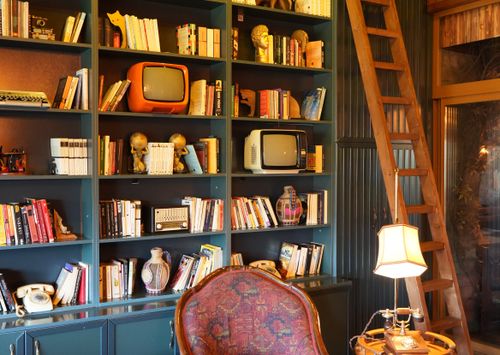
You do not need a library. You need a corner that signals to your brain that the outside world can wait. A few specifics make a real difference.
- Light: a lamp with a warm bulb — around 2700K — placed at shoulder height and angled over the page, never behind you.
- A chair with arms: you will be there for an hour at a time, and heavy hardbacks are unforgiving to tired wrists.
- A side table within reach: mug, coaster, bookmark, and a notebook for the character lists that Victorian serials almost demand.
- A blanket or throw in wool or brushed cotton, kept on the back of the chair so it is never a decision.
- A quiet hour: pick a fixed slot — half past eight, most nights — and protect it.
An edition with notes and a decent map repays its cost within a chapter. Dickens wrote fast and assumed his readers knew the shorthand of his city; modern annotations quietly translate it back.
Where to Begin
- A Christmas Carol — a single sitting, and the perfect test of whether you enjoy his voice.
- Great Expectations — tightly plotted, atmospheric, and built on the fear of shame.
- Oliver Twist — the London of the streets, raw and vivid.
- Bleak House — the great one, if you are ready for a long winter project.
- David Copperfield — the warmest of them, and the most autobiographical.
Reading in Instalments
Dickens published most of his fiction in monthly parts, and his readers waited weeks for the next chapter. You can recreate that rhythm with a book group or a friend: agree on an instalment a week, then talk about it. The cliffhangers hit harder, the speculation is half the fun, and the arguments about motives are exactly the ones Victorian families were having over breakfast.
Reading aloud works too. Dickens performed his own work to packed halls, and his dialogue was written to be spoken. Try the opening of Bleak House or the Cratchit dinner on a cold evening. The city will fill the room, and the cosy corner will do the rest.
tag: Classic Literature

Charlotte Bevan Author
From locked rooms to family secrets, the country house setting offers a perfect closed circle for suspense, suspicion, and clever detective work.
YOU MAY ALSO LIKE
The Rise of the British Country House Mystery
Aug 2
10Familiar investigators and evolving personal lives create a comforting rhythm, while each new case delivers fresh puzzles and satisfying resolutions.
read more
Why Detective Series Keep Readers Coming Back
Jul 28
10Between the wars, writers like Agatha Christie and Dorothy L. Sayers perfected the clue-puzzle mystery, blending fair play with ingenious plotting.
read moreBook Reviews
-

ERRIC CATONA
These celebrated works blend observation, memoir, and landscape history, encouraging readers to look more closely at the natural world around them.
May 19, 2016 at 5.12 pm
Reply
ERRIC CATONA
From farming diaries to island life, these memoirs offer honest, evocative accounts of remote communities, seasonal rhythms, and the challenges of rural living.
May 19, 2016 at 5.12 pm
Reply -
ERRIC CATONA
Question the author's sources, consider the context, and compare multiple perspectives to build a richer understanding of past events and interpretations.
May 19, 2016 at 5.12 pm
Reply
Author Interviews
Your email address will not be published.